
Keep On Your Feet
The Foot, Ankle & Gait Clinic


Problems we see all the time
-
Heel pain (at the back and under the heel)
-
Ankle pain
-
Forefoot pain
-
Numbness in the toes and feet
-
Pain in your big toe joint
-
Pain that is worse in the morning or evening
-
Pain that doesn't improve, or is worse, with rest
-
People struggling to do what they enjoy.
Treatments we offer:
-
Simple and chair-side insoles
-
Modular orthotics
-
Custom orthotics
-
Exercise programs
-
Taping
-
Footwear advice
-
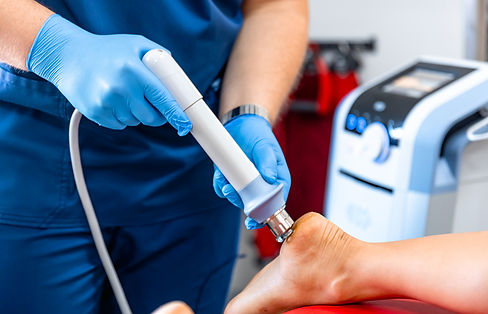
Shockwave therapy (Radial & Focused)
-
Gait re-training
-
Soft-tissue therapy
-
Foot mobilisations
How much do foot pain appointments cost?
Going private can seem quite scary as the costs can mount up, so it is our policy to be as transparent as possible.
General Appointments Pricing
First Appointment - £95
Includes: history taking, diagnosis, treatment planning, exercise prescriptions, footwear advice, basic insole customised for you.
Follow-up (General)- £65
Includes: Tracking your progress, updating treatment plans, modifying previous insole, modifying exercise programmes, casting/scanning for bespoke orthotics.
Specialist Follow-Up Appointments Pricing
Shockwave Package (3 sessions)- £180
Shockwave is a really powerful treatment that helps to speed up the healing process in patients with certain bone and soft tissue problems, such as:
-
Plantar fasciitis,
-
Achilles tendinitis
-
Tibialis posterior tendinitis.
It works best when offered as a package of three sessions, offered 1-2 weeks apart and done as part of a treatment program which includes exercises, activity modification and possibly insoles. All of these are reviewed at each appointment.
Insoles & Orthotics - £30, £70, £250-350
A basic insole customised to your needs may be issued in your initial consultation.
Further pairs of these are £30 each.
If your foot requires more support or has more complex needs, the next level of insole/orthotic offered is £70 and this will be a modular device customised to your needs.
Once the optimum prescription has been identified for you, it may then be worthwhile considering a custom-made orthotic that will prevent future issues (although this is not often necessary).
These can vary in price, but generally they range from £250-£350 depending on the complexity of the device and the materials used. Most people do well with what they are given in their first appointment.
What a typical foot / ankle pain and injuries appointment with us looks like:
Foot & Ankle Pain appointments can vary according to where you go, and who you see. So here's what you can expect from us:
-
The appointment starts with you telling me what it is that brings you in. I will then ask a series of questions that help me narrow down the issue(s).
-
Examination of the problematic area follows - so the foot/ankle is looked at in detail and moved around to identify any issues.
-
Standing and walking assessment or gait analysis may follow, although if you are walking with a limp due to your injury, then initially a treatment plan may be created without this step.
-
Your diagnosis and treatment plan will be discussed with you and you will be given the chance to ask questions.
-
If the plan is to proceed with orthotics, then these will be issued at this point if we have them in stock. Alternatively, if custom orthotics are to be prescribed, then you will have moulds or 3D scans taken of your feet. These are then manufactured by an external laboratory and typically take 2-6 weeks to be made. Faster turn-arounds are available, but typically come at a premium.
-
Exercises may be discussed with you or may be sent to you after your consultation.
-
We may proceed with other treatments, time-allowing, such as Focused or Radial Shockwave Therapy, taping, soft tissue therapy or foot mobilisation techniques.
Ultrasound scans may sometimes be offered as part of the appointment or may require you to return at a later date for a separate appointment.
We send out a New Patient Intake Form. This is a detailed form that captures information about your health and gets all of the basic admin out of the way. Nobody likes admin, and we consider it a waste of your paid-for time with us to have you giving us information that can be dealt with ahead of time.
It will ask you for:
-
Your basic information (name, address, emergency contact, shoe size and body weight)
-
Your GP surgery
-
Your medical history, including allergies and what medications you take.
-
Various consents ahead of the appointment.
-
We make use of an "AI Scribe" during the appointment. This basically just writes a summary of the things we discuss and helps to make sure any follow-up tasks are noted down.
This allows the clinician to focus on what you're saying and means that a summary of the discussion can be sent to you after, as long as you have consented to the use of AI.
It also means that our notes about your care are able to be more thorough.
We try to allow as much time as you need to discuss what is going on for you. In the overwhelming majority of cases, the discussion takes no more than 15 minutes. In very rare instances (for particularly complex cases) we may use a majority of the appointment on this section as, this is the bit that guides physical examination and treatment planning.
Initially we let you freestyle what you want to tell us, as that's the bit that is important to you.
Once we have heard your story from your perspective, we will ask some more specific questions. Sometimes you may not know the answer, and that's completely fine! But, don't worry - we try to fill in whatever gaps are left from your story.
The important things that you might want to think about are:
-
Where is the pain? Taking a picture with a finger pointing at the painful bit is helpful - or even drawing on your foot.
-
When did it start? What were you doing? What shoes were you wearing?
-
How would you describe the pain?
-
Is it localised to one spot or does it move around? Where does it start? Where does it move to?
-
Are there any other bits that hurt when the main problem hurts? Are there any bits that hurt before or after that main bit starts hurting? Have you had issues with aches and pains in the past?
-
When does the pain come on during the day? Morning? Evening? After walking for ____ time?
-
What makes the pain better or worse?
-
When is the pain worst? When is it ok? When was it the worst it has been?
-
A lot of this happens when you are telling us your story, but we then examine your foot and ankle to see what is wrong.
Then, we will look at how your foot and ankle are when you are sitting, standing and walking.
We also check how the various joints move and how strong the muscles in your feet are.
Once we have done this, we palpate (poke at) various parts of your foot and ankle to see what hurts. Using our knowledge of how the foot is put together, and what hurts at various points, we can get a really good idea of what the problems might be.
We also use clinical tests to confirm what the problem is. These are special ways of handing the injured bit that allow us to predict with decent certainty what is actually wrong with your foot or ankle.
Most of the people we see do not need any scans or imaging, however, it is sometimes necessary.
We are able to undertake ultrasound scans on-site and, depending on the likely complexity of the scan and time available, it may be undertaken as part of your appointment (time also allocated for reporting on the scan).
For MRI or other scans, we can liaise with your GP to facilitate this.
Not all insoles are created equal!
The shear variety of insoles that are available is eye-watering, and the insoles that may be used as part of your treatment are likely to be more sturdy and supportive than over-the-counter varieties.
Likewise, even prescribed insoles can vary in their prescription, and if you have tried them and they did not work, this can also provide us with really helpful information.
Think about it like this:
A Ferrari is a pretty awesome car and it is possibly one of the best cars on the road, but if you take it off roading, you'll probably run into trouble. Meanwhile, a Toyota Hilux is unlikely to win any beauty contests or win at a track day - unlike a Ferrari - but if you go offroading or want something that is almost bomb-proof, then it's probably what you need.
The moral of the story being: Those are two cars which are very capable, but would really struggle if they were in the wrong environment or used for the wrong role.

Still have some questions...?
About the Author
Jeremy is the owner at Swansea's Foot & Ankle clinic: Keep On Your Feet. All the information found on this page was written by him (there's no AI or Chat-GPT here!), and has been carefully chosen to provide you with the information that you need to know about the clinic. Jeremy has a Bachelor of Science in Podiatry, with honours, a Post-Graduate Certificate in Podiatric Sports Medicine, a Post-Graduate Diploma in Medical Ultrasound, and two Master's of Science degrees in the Theory of Podiatric Surgery, and Sports & Exercise Medicine.